Think of the word supercar. What image forms in your mind? Is it a car draped in dramatic curves, filled with screens, and whispering in electric silence? Or does your mind travel back to a different era, to a machine that was raw, visceral, and unapologetically brutal? For a generation of enthusiasts, the latter is perfectly encapsulated in one name, a name that still sends a shiver down the spine: the Ferrari F40.
The Ferrari F40 transcends the very definition of an automobile. It exists as a powerful symbol of a bygone era, a roaring farewell from its legendary founder, Enzo Ferrari. This machine embodies a relentless and single-minded pursuit of performance above all else. It serves as a vibrant time capsule from a period when supercars were thrilling, dangerous, and vibrantly alive, connecting the driver directly to the road and the raw mechanics of the car.
A Farewell Gift from Il Commendatore
To understand the F40, you must first understand the context of its birth. The mid-1980s were a time of intense competition, particularly with Ferrari’s archrival from Sant’Agata Bolognese, Lamborghini. The Countach, with its outrageous scissor doors and aerospace-inspired design, was the poster car on every teenager’s wall. Ferrari had responded with the 288 GTO, a homologation special for Group B racing, but the series was canceled before the car could truly prove its mettle.
Enzo Ferrari, known as Il Commendatore, saw an opportunity. He wanted a car that would celebrate Ferrari’s 40th anniversary, a car that would be a fitting capstone to his life’s work. The project, codenamed F120, was led by the brilliant engineer Nicola Materazzi, with design by Pininfarina’s Leonardo Fioravanti. The brief was simple, yet incredibly demanding: create the ultimate performance car.
The F40 was to be a successor to the 288 GTO, but it was so much more. It was a machine stripped of any unnecessary weight, a car that was, in many ways, a race car for the road. This philosophy would define its character and cement its status as an icon.
The Anatomy of a Beast: Form Follows Ferocity
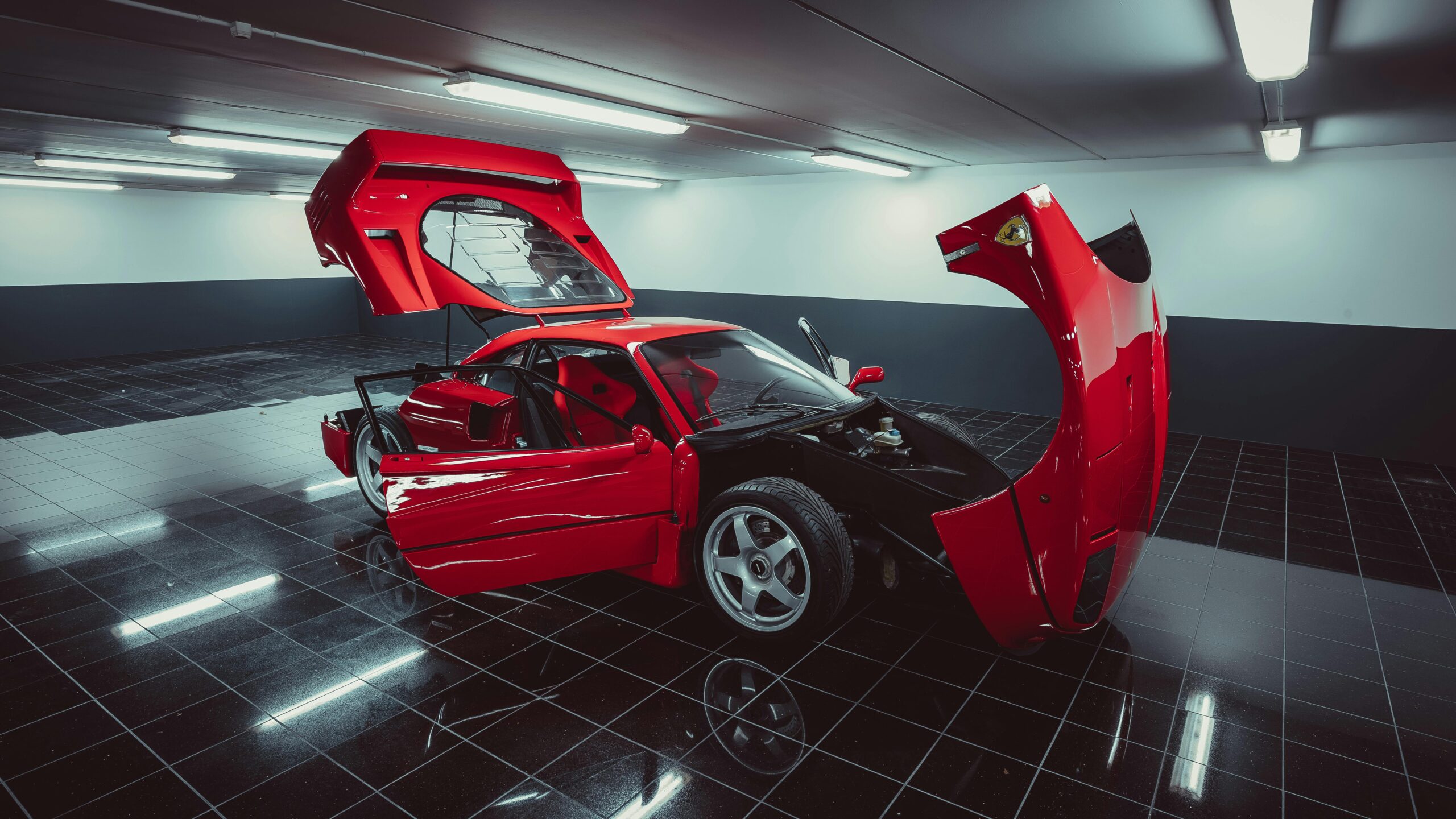
Open the iconic, lightweight red door, and you are greeted not by plush leather, but by bare carbon fiber and Kevlar. There are no door handles, just a simple fabric pull. The windows are Perspex, sliding open with a simple latch. There is no stereo, no sound deadening, and no air conditioning as standard. The carpet is a thin layer of felt. The seats are fixed shells, with adjustable pedals to bring the driving position to you. This was not a design oversight; it was a deliberate act of purism. Every decision was made in the name of saving weight. The final figure was a featherweight 2,425 pounds, a number that seems impossible by today’s standards.
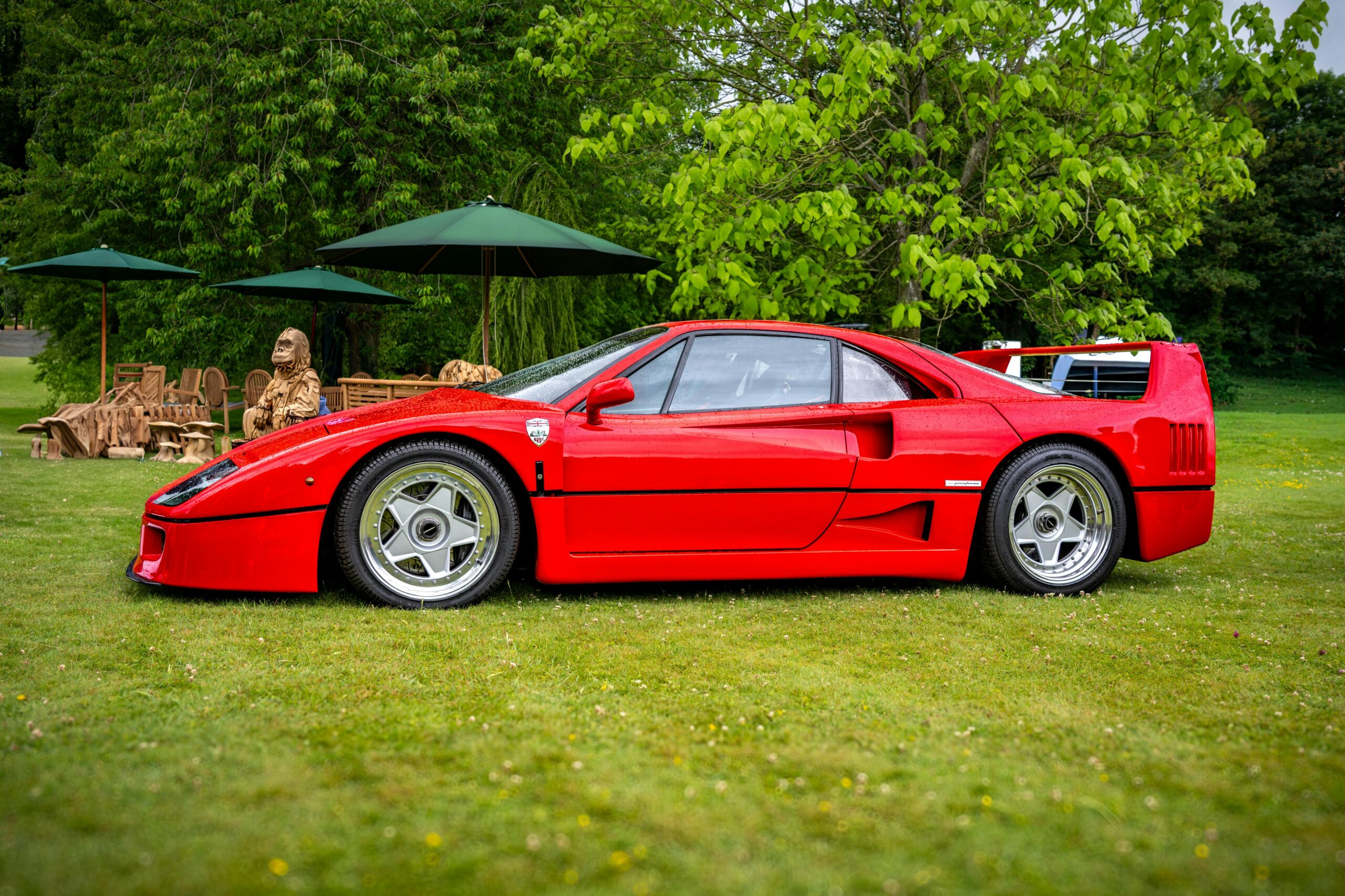
The body, a masterpiece from Pininfarina, is a study in functional aerodynamics. It is not subtly sculpted; it is starkly purposeful. That massive rear wing is not for show; it generates real downforce. The louvers on the engine cover are there to extract heat from the roaring V8 behind you. The NACA ducts on the sides feed air to the intercoolers. The front splitter manages airflow underneath the car. Every vent, every scoop, every crease has a job to do. The F40 wears its engineering on its sleeve, and its silhouette remains one of the most recognizable and emotionally charged in automotive history.
The Heart of the Matter: A Twin-Turbocharged Symphony
Lift the rear clamshell, and there it sits: the heart of the beast. The F40’s engine is a 2.9 liter twin-turbocharged V8, an evolution of the unit from the 288 GTO. In a world now accustomed to hybrid powertrains and electric torque, its output of 478 horsepower may not sound earth-shattering. But context is everything. In 1987, this was a staggering number, making the F40 the first production car to break the 200 mph barrier, with a claimed top speed of 201 mph.
The power figure, however, tells only half the story. The real magic, and the terror, lies in its delivery. The turbos of the 1980s were not the refined, seamlessly integrated units of today. They suffered from lag. At low revs, the engine feels almost docile. But then, as the tachometer needle sweeps past 4,000 RPM, the turbos spool up with a violent surge. It is not a linear increase in power; it is an explosion. The car catapults forward with a ferocity that can catch out the unwary, accompanied by a cacophony of mechanical sounds: the scream of the engine, the whine of the gears, and the whoosh of the turbos. It is an intense, demanding, and utterly intoxicating experience. Driving an F40 fast is not a passive activity; it is a physical negotiation with forces of nature.
The Driving Experience: Pure, Unfiltered Connection
Sitting in the spartan cockpit, you are connected to the car in a way that is unimaginable in a modern supercar. You feel every vibration through the thin, fabric-wrapped steering wheel. You hear every mechanical click and whirr from the gearbox behind you. The chassis, a tubular steel space frame, is stiff and communicative. The suspension is firm, telling you everything about the road surface beneath you.
This is a car that demands your absolute attention. There is no traction control, no stability control, and no anti-lock brakes that are not a rudimentary early system. The driver is the central computer, the one who must manage the turbo lag, the raw power, and the razor-sharp handling. It is unforgiving. Make a mistake, and it will not correct it for you. But get it right, and the reward is a feeling of pure, unadulterated joy. It is the feeling of being an extension of the machine, of achieving a perfect harmony between man and metal. This raw, unfiltered connection is the F40’s most precious commodity, a quality that has been engineered out of many contemporary performance cars in the name of safety and accessibility.
The Legacy: The Last of its Kind
The Ferrari F40 was produced from 1987 to 1992, with just 1,315 units built. It was an instant classic, a car that defined an era and set a benchmark for what a supercar should be. It was followed by the F50 and the Enzo, both incredible machines in their own right, but both more complex, more refined, and in some ways, more sanitized. The F40 was the last of a bloodline that traced directly back to the racing cars of the 1950s and 60s.
Its legacy is multifaceted. It cemented Ferrari’s reputation as the builder of the world’s most desirable performance cars. It won the horsepower war of the 80s and set the stage for the hypercar battles to come. But more importantly, it captured a specific moment in time. It was the end of an analog era. It was a car built not by computers, but by the passion, intuition, and sheer force of will of its creators, led by Enzo Ferrari himself.
Today, the F40 is a blue-chip collector’s item, a million-dollar machine that is rarely driven to its limits. But when you see one, whether it is static at a concours event or, if you are very lucky, heard screaming down a country road, it commands a unique reverence. It is not just a beautiful object; it is a piece of history, a symbol of a philosophy that prized emotion over perfection and sensation over simulation.
The F40 in a Modern World
In 2024, we are surrounded by cars that are objectively better in every measurable way. A modern Porsche 911 Turbo S is faster in a straight line, more comfortable, more economical, and infinitely easier to drive quickly. An electric hypercar like the Rimac Nevera can deliver acceleration that would leave an F40 feeling pedestrian. They are technological marvels, and they deserve our admiration.
But they do not stir the soul in the same way. They lack the drama, the sense of occasion, and the raw, untamed edge. The F40 is not a car you simply get into and drive. It is a car you prepare for, you respect, and you remember. Its imperfections are precisely what make it perfect. The turbo lag, the noise, and the lack of comfort are not flaws; they are features. They are the ingredients of a character that is utterly compelling.
Owning and driving an F40 today is a pilgrimage back to a purer form of motoring. It reminds us of a time when speed was felt through the seat of your pants, not read from a digital display. It is a testament to the idea that the journey, with all its challenges and sensory overload, is more important than the destination.
Conclusion: The Eternal Flame
The Ferrari F40 is more than just metal, rubber, and glass. It is the embodiment of a relentless pursuit of performance. It is the roaring farewell of a legendary founder. This reminds us that in our increasingly digital and sanitized world, there is immense value in something that is raw, analog, and demanding. The F40 does not ask you to like it; it dares you to master it. And in that challenge, it offers an experience that is forever etched into the memory of anyone fortunate enough to encounter it.
The poster may have faded, but the legend has not. The Ferrari F40 remains, and will likely always remain, the ultimate supercar.